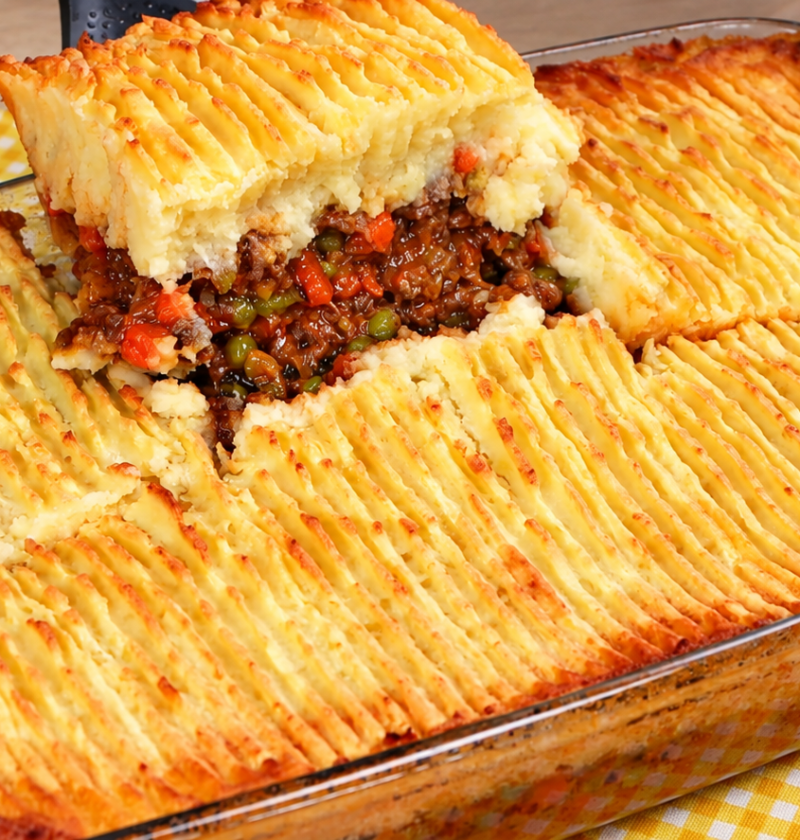
This hearty beef and vegetable pie is everything a comforting family dinner should be: rich, savory filling, tender vegetables, creamy mashed potatoes, and a golden cheesy top.
A small culinary note before we begin: a traditional Shepherd’s Pie is made with lamb, while the beef version is traditionally known as Cottage Pie. Since many home cooks use the name Shepherd’s Pie for both versions, this recipe keeps the familiar name while using ground beef.
The secret to an excellent result is not complicated ingredients — it is technique. The beef should be properly browned rather than steamed, the gravy should be thick enough to support the mashed potato layer, and the potatoes should be dry and fluffy before butter, milk, and egg yolk are added.
Follow the steps below carefully and you will get a beautifully layered family dinner that holds its shape when served but still stays juicy and comforting inside.
Recipe Overview
Prep time: 30 minutes
Cooking time: about 30 minutes
Baking time: 20–25 minutes
Resting time: 10 minutes
Total time: about 1 hour 30 minutes
Servings: 6
Baking dish: approximately 30 × 20 cm
Oven temperature: 200°C conventional / 180°C fan
Difficulty: Easy to intermediate
Cuisine: British-inspired
Method: Stovetop + oven
Ingredients
For the Mashed Potato Topping
- 1 kg potatoes, peeled and diced
- 1 garlic clove
- 5 g salt, about 1 teaspoon, for the cooking water
- 1 egg yolk
- 15 g butter
- 120 ml milk, warmed
- 28 g Cheddar cheese, finely grated
For the Beef and Vegetable Filling
- 15 ml olive oil
- 1 medium onion, about 120 g, finely diced
- 2 garlic cloves, finely minced
- 200 g carrots, diced small
- 200 g peas, fresh or frozen
- 500 g ground beef
- 1 teaspoon dried thyme, about 1 g
- ½ teaspoon ground black pepper, about 1 g
- 1 teaspoon sweet ground paprika, about 2–3 g
- 1 teaspoon salt, about 5 g
- 30 g tomato paste, about 2 tablespoons
- 32 g all-purpose flour, about 4 level tablespoons
- 480 ml water
Optional for Extra Flavor
- 10 ml Worcestershire sauce
- 1 small bay leaf
- 5 g chopped fresh parsley
- extra Cheddar for a stronger cheese crust
Which Potatoes Are Best?
For the fluffiest mashed potato topping, use a floury or all-purpose potato.
Good choices include:
- Russet
- Maris Piper
- King Edward
- Yukon Gold
Waxy potatoes can be used, but the mash may become denser and slightly more elastic.
Chef’s tip:
Avoid overworking mashed potatoes. Too much stirring releases excess starch and can turn them gluey.
Equipment
You will need:
- large saucepan
- large frying pan or sauté pan
- colander
- potato masher
- large mixing bowl
- wooden spoon
- whisk
- 30 × 20 cm baking dish
- kitchen scale
- cutting board
- sharp knife
Detailed Step-by-Step Instructions
1. Prepare the Potatoes
Peel 1 kg potatoes.
Cut them into even cubes, roughly 3–4 cm.
Why Even Pieces Matter
Potatoes that are similar in size cook at the same speed.
If some pieces are very small and others are large, the small ones may become waterlogged before the larger pieces are tender.
2. Place the Potatoes in a Saucepan
Transfer the diced potatoes to a large saucepan.
Add 1 peeled garlic clove.
Pour in just enough cold water to cover the potatoes by about 1–2 cm.
Add 5 g salt.
Why Start with Cold Water?
Starting potatoes in cold water allows the centers and exteriors to heat gradually and cook evenly.
If you drop large raw potato pieces directly into boiling water, the outside may become soft before the center is fully cooked.
3. Bring to a Boil
Place the saucepan over high heat and bring the water to a boil.
Once boiling, reduce the heat to maintain a steady simmer.
Cook uncovered for about 15–20 minutes.
4. Check the Potatoes
Insert the tip of a knife into one of the larger pieces.
The potatoes are ready when the knife slides through without resistance.
Do not continue boiling them once they are tender.
Overcooked potatoes absorb more water, which can make the mash loose and watery.
Prepare the Filling While the Potatoes Cook
5. Dice the Vegetables
Finely dice the onion.
Cut the carrots into small cubes, about 5–8 mm.
Mince the 2 garlic cloves.
Why Cut the Carrots Small?
Small carrot pieces soften within the relatively short cooking time and distribute evenly through the beef filling.
Large pieces may remain too firm.
6. Heat the Olive Oil
Place a large frying pan over medium heat.
Add 15 ml olive oil.
Let it heat for about 30 seconds.
The oil should become fluid and glossy, but it should not smoke.
7. Sauté the Onion
Add the diced onion.
Cook for about 3–4 minutes, stirring occasionally.
The onion should soften and become slightly translucent.
You do not need to brown it deeply.
8. Add the Carrots
Add the diced carrots.
Cook together with the onion for about 4–5 minutes.
This gives the carrots a head start before the beef is added.
Chef’s tip:
This small change makes a major difference. Carrots added too late often stay unpleasantly crunchy.
9. Add the Garlic
Add the minced garlic.
Cook for only about 30–60 seconds.
Stir constantly.
Do Not Brown the Garlic
Garlic can become bitter very quickly.
As soon as it smells fragrant, move to the next step.
Browning the Beef
10. Add the Ground Beef
Add 500 g ground beef to the pan.
Break it into chunks with a wooden spoon.
Let some of the beef sit undisturbed against the hot pan for short periods.
Why?
If you stir constantly from the first second, the meat tends to steam.
Allowing direct contact with the hot pan creates browning and a much deeper savory flavor.
11. Cook Until Properly Browned
Cook for about 6–8 minutes.
Break the beef into smaller pieces as it cooks.
Continue until there is no visible raw pink meat.
If a large amount of fat collects in the pan, you can carefully spoon some of it out.
Do not remove every drop — a little fat adds flavor to the gravy.
12. Add the Seasonings
Add:
- 1 teaspoon dried thyme
- ½ teaspoon black pepper
- 1 teaspoon paprika
- 1 teaspoon salt
Stir well.
Cook for about 30 seconds so the spices warm in the pan.
Chef’s Secret
Briefly heating dried spices in the fat helps release more aroma than simply stirring them into the finished sauce.
Build the Gravy
13. Add the Tomato Paste
Add 30 g tomato paste.
Stir it into the beef and vegetables.
Cook for about 1–2 minutes.
Why Cook Tomato Paste?
Raw tomato paste can taste sharp and metallic.
Cooking it briefly:
- deepens the flavor;
- reduces raw acidity;
- adds color;
- creates more savory richness.
14. Sprinkle in the Flour
Sprinkle 32 g all-purpose flour evenly over the beef mixture.
Stir continuously until no dry flour is visible.
Cook for about 1 minute.
Why Is the Flour Added Before the Water?
Coating the meat and vegetables with flour first prevents large lumps from forming when the liquid is added.
The flour also thickens the final gravy.
15. Add Water Gradually
Pour in about one quarter of the 480 ml water.
Stir vigorously until smooth.
Add another portion and stir again.
Continue until all the water has been incorporated.
Do Not Pour It All in at Once
Gradual addition makes it much easier to create a smooth gravy.
16. Simmer the Filling
Bring the mixture to a gentle simmer.
Cook for about 8–10 minutes, stirring occasionally.
The gravy should reduce and thicken.
The Correct Consistency
The filling should be moist and saucy, but not watery.
When you drag a spoon through the pan, the sauce should briefly leave a visible trail.
This is important because a watery filling can make the mashed potato topping sink.
17. Add the Peas
Add 200 g peas during the last 3–4 minutes of simmering.
Frozen peas can be added directly from frozen.
Why Add Peas Near the End?
Peas cook very quickly.
Long cooking can make them dull, wrinkled, and overly soft.
18. Taste and Adjust
Taste the filling.
Add a little more pepper or salt if needed.
Remember that the mashed potato topping and Cheddar will also add seasoning.
Finish the Potatoes
19. Drain Thoroughly
Once the potatoes are tender, drain them in a colander.
Return them to the hot saucepan or transfer them to a large bowl.
Let them steam for about 2–3 minutes.
This Step Is Important
Excess surface moisture needs to evaporate.
Drier potatoes make fluffier mash and a more stable topping.
20. Mash the Potatoes
Mash the hot potatoes and cooked garlic using a potato masher.
Work until no large lumps remain.
Do not use a blender or food processor.
Why Not?
Fast blades overwork potato starch and can turn mashed potatoes into a sticky paste.
21. Add the Butter
Add 15 g butter while the potatoes are still steaming hot.
Mash or stir gently until melted.
Adding the fat first helps coat some of the starch and improves the texture.
22. Add the Warm Milk
Warm 120 ml milk.
Add it gradually rather than all at once.
Mix gently after each addition.
Why Warm Milk?
Cold milk cools the potatoes quickly and does not incorporate as smoothly.
Warm milk produces a creamier mash.
23. Add the Egg Yolk
Allow the mash to cool for about 2–3 minutes so it is still hot but no longer aggressively steaming.
Add 1 egg yolk.
Mix immediately until completely incorporated.
Why Add Egg Yolk?
Egg yolk gives the topping:
- richer flavor;
- a smoother texture;
- improved browning;
- slightly better structure when baked.
24. Check the Mash
The mashed potatoes should be smooth, creamy, and spreadable.
They should not be runny.
If they seem too thick, add an extra tablespoon of warm milk.
If they seem very soft, do not add more liquid.
Assemble the Pie
25. Preheat the Oven
Preheat the oven to:
200°C conventional
or
180°C fan
26. Add the Beef Filling to the Dish
Transfer the beef and vegetable filling to a baking dish about 30 × 20 cm.
Spread it into an even layer.
Important
If the filling still looks very watery, simmer it a little longer before assembling.
A thick filling is essential for neat layers.
27. Let the Filling Cool Slightly
If possible, let the filling stand for about 5–10 minutes before adding the potatoes.
It does not have to become cold.
Why?
Very hot, thin filling can make the potato topping sink into the meat layer.
A few minutes of cooling helps the gravy thicken slightly.
28. Add the Mashed Potatoes
Spoon the mashed potato over the beef in several separate portions.
Do not dump all of it into the center.
Beginner’s Trick
Place spoonfuls around the entire surface first, then gently connect them.
This is much easier than trying to drag a heavy mound of potatoes over the filling.
29. Spread Gently
Use the back of a spoon or a spatula to spread the mash all the way to the edges.
Try to seal the filling underneath.
This helps prevent the gravy from bubbling over the top too much.
30. Create Texture on the Surface
Run a fork over the mashed potatoes to create small ridges.
Why?
The raised ridges brown more strongly in the oven.
They create the characteristic golden, slightly crisp top.
31. Add the Cheddar
Sprinkle 28 g finely grated Cheddar evenly over the mashed potato.
For a stronger cheese flavor, you can increase the amount to 50–60 g.
Bake the Pie
32. Bake at 200°C
Place the dish on the middle rack.
Bake for 20–25 minutes.
The pie is ready when:
- the filling is bubbling gently around the edges;
- the potato topping is hot;
- the cheese is melted;
- the surface has golden patches.
33. Optional Extra Browning
If the pie is fully hot but still pale, use the grill/broiler for 2–3 minutes.
Watch it continuously.
Cheese can go from golden to burnt very quickly.
Rest Before Serving
34. Let the Pie Rest
Remove the dish from the oven.
Let it stand for 10 minutes before serving.
Why Resting Matters
Immediately after baking, the filling is extremely hot and relatively loose.
During the rest:
- the gravy thickens slightly;
- the layers stabilize;
- portions hold their shape better;
- the pie is safer to eat.
How to Serve
Serve generous spoonfuls or cut into portions with a wide serving spatula.
This pie is already a complete meal, but it pairs beautifully with:
- steamed green beans;
- roasted Brussels sprouts;
- cabbage;
- green salad;
- broccoli;
- buttered peas.
Chef’s Best Tips
1. Cut Potatoes Evenly
Even pieces cook at the same speed.
2. Steam-Dry the Potatoes
After draining, give them 2–3 minutes to release excess moisture.
This is one of the secrets to fluffy mash.
3. Add Butter Before Milk
Fat coats the potato starch and gives a smoother texture.
4. Add Milk Gradually
You may not need every last drop depending on the potato variety.
5. Do Not Blend Mashed Potatoes
A food processor can turn them gluey.
6. Brown the Beef Properly
Do not continuously stir from the first second.
Allow the meat to make contact with the hot pan.
7. Cook the Tomato Paste
One or two minutes of cooking gives a noticeably richer flavor.
8. Add Flour Before Liquid
This makes a smoother gravy.
9. Add Water Gradually
It prevents flour lumps.
10. Reduce the Filling Properly
A watery filling is the most common reason for a sloppy pie.
11. Add Peas Near the End
This keeps them brighter and more tender.
12. Cool the Filling Slightly Before Topping
The mashed potato will be easier to spread.
13. Add the Potato in Small Spoonfuls
This prevents the filling from being pushed around.
14. Rough Up the Surface with a Fork
More ridges mean more delicious browned edges.
15. Rest the Finished Pie
Ten minutes dramatically improves portioning.
Common Mistakes and How to Fix Them
The Filling Is Too Watery
Simmer it uncovered for several additional minutes.
The gravy should coat the meat rather than pool like soup.
The Filling Is Too Thick
Add 30–60 ml additional water and stir.
Heat briefly until smooth.
The Mashed Potatoes Are Runny
Too much milk may have been added.
Do not add more liquid.
Let the potatoes stand briefly so the starch can absorb some moisture.
The Mash Is Gluey
The potatoes were probably overmixed.
Next time use a hand masher and stop once the potatoes are smooth.
The Potato Layer Sinks Into the Beef
Possible causes:
- filling was too watery;
- filling was extremely hot;
- mash was too thin.
Allow the filling to thicken and cool briefly.
The Top Does Not Brown
Use a fork to make ridges and finish under the grill for 2–3 minutes.
The Pie Falls Apart When Served
It probably needs to rest.
Wait at least 10 minutes after baking.
Variations
Traditional Shepherd’s Pie
Replace the ground beef with 500 g ground lamb.
This makes the dish a traditional Shepherd’s Pie.
Cheesy Cottage Pie
Increase the Cheddar to 60–80 g.
Extra Vegetable Version
Add:
- 100 g diced celery;
- 100 g mushrooms;
- 100 g sweet corn.
Richer Gravy
Replace part of the water with beef stock.
Worcestershire Version
Add 10 ml Worcestershire sauce with the water for deeper savory flavor.
Storage
Allow leftovers to cool.
Store covered in the refrigerator for up to 3 days.
Do not leave the cooked pie at room temperature for long periods.
Reheating
In the Oven
Cover loosely and heat at 180°C for 20–25 minutes, or until piping hot in the center.
Remove the cover for the final 5 minutes.
In the Microwave
Heat individual portions until thoroughly hot.
The top will be softer than when reheated in the oven.
Can Shepherd’s Pie Be Frozen?
Yes.
You can freeze it either before or after baking.
To Freeze Before Baking
- Assemble the pie.
- Cool completely.
- Cover tightly.
- Freeze for up to about 2 months.
- Thaw overnight in the refrigerator.
- Bake until completely hot throughout.
To Freeze Leftovers
Divide into individual portions and freeze in airtight containers.
Nutrition
Approximate nutrition per serving when divided into 6 portions:
- Calories: about 450–500 kcal
- Protein: about 24–27 g
- Fat: about 20–24 g
- Carbohydrates: about 42–48 g
- Fiber: about 6–7 g
- Sugars: about 7–9 g
The actual values depend mainly on the fat content of the ground beef, the milk used, and the amount of olive oil and cheese.
FAQ
Is This Shepherd’s Pie or Cottage Pie?
Technically, because this recipe uses beef, it is Cottage Pie.
Traditional Shepherd’s Pie is made with lamb.
Can I Use Lamb Instead?
Yes.
Use 500 g ground lamb for a traditional version.
Which Potatoes Are Best?
Floury potatoes such as Russet, Maris Piper, or King Edward make the fluffiest topping.
Do I Need to Peel the Potatoes?
For a smooth classic topping, yes.
For a rustic version, thin potato skins can be left on.
Why Is Garlic Added to the Potato Water?
The garlic cooks until soft and gets mashed directly into the potatoes, giving a gentle garlic flavor without harshness.
Can I Skip the Egg Yolk?
Yes.
The mash will still work, but the yolk adds richness and helps with browning and structure.
Can I Use Cream Instead of Milk?
Yes.
For a richer topping, replace part or all of the milk with cream.
Can I Use Plant-Based Milk?
Yes.
Choose an unsweetened, neutral-flavored variety.
Why Should the Milk Be Warm?
Warm milk incorporates more smoothly and keeps the potatoes hot.
Can I Use Frozen Peas?
Yes.
Add them directly from frozen near the end of cooking.
Should I Cook the Carrots First?
Cooking them with the onion for several minutes before adding the beef helps ensure they become tender.
Can I Use Frozen Mixed Vegetables?
Yes.
Add them after the beef is browned and adjust the cooking time as needed.
What Does the Flour Do?
It thickens the liquid and creates the gravy that holds the filling together.
Can I Use Cornstarch Instead?
Yes, but it must be used differently.
Cornstarch should be mixed with cold water before being added to the simmering filling.
Why Is My Filling Watery?
It probably needs more simmering time.
Cook uncovered until the gravy visibly thickens.
Can I Use Beef Stock Instead of Water?
Yes.
Beef stock gives deeper flavor.
Use low-salt stock so you can control the final seasoning.
Can I Make It Ahead?
Absolutely.
Assemble the pie, cover, and refrigerate for up to 24 hours before baking.
Because it will be cold, it may require a little extra oven time.
Can I Make the Filling the Day Before?
Yes.
Cool it completely and refrigerate.
Assemble with fresh mashed potatoes the next day.
How Do I Keep the Potato from Sinking?
Make sure the filling is thick, let it cool briefly, and place the mash on top in small spoonfuls before spreading.
Can I Pipe the Potatoes?
Yes.
For a decorative top, pipe the mashed potato with a large star nozzle.
The ridges become beautifully golden.
Do I Need Cheese?
No.
The cheese is optional but adds a savory golden crust.
What Cheese Can Replace Cheddar?
Good alternatives include:
- mature Gouda;
- Gruyère;
- Emmental;
- Red Leicester.
Why Rest the Pie Before Serving?
Resting gives the hot gravy time to thicken and helps the portions hold together.
Can I Cook It in Individual Dishes?
Yes.
Divide the filling and mash among ramekins and bake until golden and bubbling.
The baking time may be shorter.
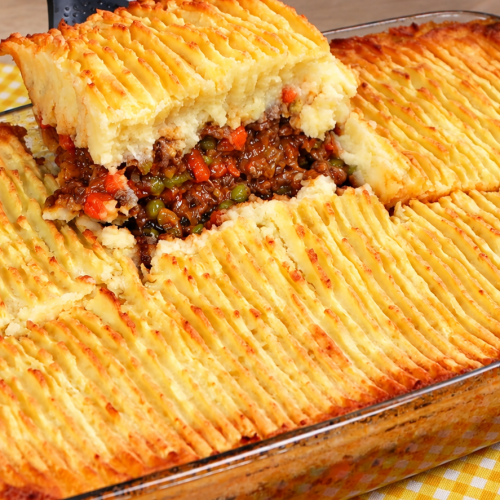
Perfect Shepherd’s Pie-Style Cottage Pie
Instructions
- Place the diced potatoes and 1 garlic clove in a saucepan and cover with cold water.
- Add 5 g salt, bring to a boil, then simmer uncovered for 15–20 minutes until tender.
- Meanwhile, heat olive oil in a large frying pan.
- Sauté the onion for 3–4 minutes.
- Add carrots and cook for another 4–5 minutes.
- Add minced garlic and cook for 30–60 seconds.
- Add the ground beef and cook for 6–8 minutes, breaking it apart until browned.
- Add thyme, black pepper, paprika, and salt.
- Stir in tomato paste and cook for 1–2 minutes.
- Sprinkle the flour over the beef and stir for 1 minute.
- Gradually add 480 ml water, stirring until smooth.
- Simmer for 8–10 minutes until the gravy thickens.
- Add peas during the last 3–4 minutes.
- Drain the cooked potatoes and let them steam dry for 2–3 minutes.
- Mash the potatoes and cooked garlic.
- Stir in butter, then gradually add warm milk.
- Mix in the egg yolk.
- Preheat the oven to 200°C conventional / 180°C fan.
- Spread the beef filling in a 30 × 20 cm baking dish.
- Spoon the mashed potato evenly over the filling and spread gently.
- Rough up the surface with a fork.
- Sprinkle with 28 g grated Cheddar.
- Bake for 20–25 minutes until bubbling and golden.
- Rest for 10 minutes before serving.