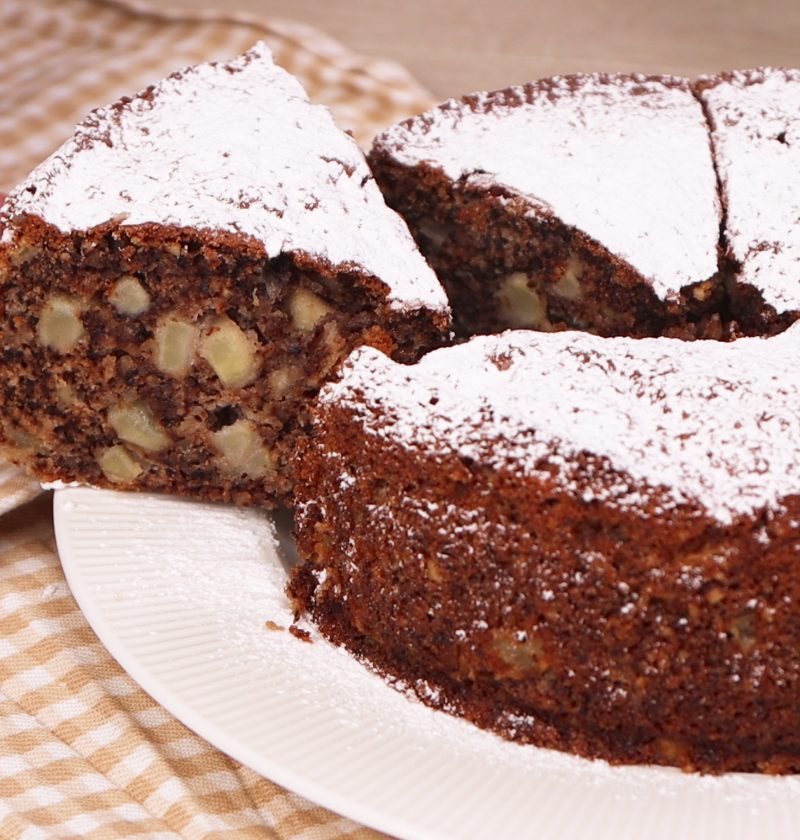
This Apple Walnut Cake is moist, nutty, lightly spiced by the natural flavor of Granny Smith apples, and surprisingly light in texture considering how rich the batter is.
The secret is in the method. The walnuts are ground very finely, the apples are folded directly into the flour mixture, and the egg whites are whipped separately before being gradually incorporated into the thick batter. This gives the cake lift without needing a large amount of fat.
Granny Smith apples are especially good here because their tartness balances the sugar and walnuts beautifully. A little lemon juice keeps the apple pieces from turning brown and also adds a fresh note.
This is not a pourable cake batter. Before the egg whites are added, the mixture will look unusually thick. That is completely normal. The most important part is loosening the batter gradually with a small amount of whipped egg white before folding in the rest.
Recipe Overview
Prep time: about 30 minutes
Bake time: 40–45 minutes
Cooling time: about 1 hour
Total time: about 2 hours
Servings: 10
Pan: 20 cm / 8-inch round cake pan
Oven: 180°C conventional / 165°C fan
Difficulty: Intermediate
Texture: moist, tender, nutty, and lightly airy
What Kind of Walnuts Should You Use?
Use plain, unsalted walnuts.
Fresh walnuts should smell sweet and nutty.
If they smell strongly bitter, stale, or oily, they can make the entire cake taste unpleasant.
Optional Toasting
For a deeper walnut flavor, toast them for about 5–7 minutes at 160°C, then let them cool completely before grinding.
Do not grind warm nuts because their oils are released more quickly.
Equipment
You will need:
- 20 cm / 8-inch round cake pan
- baking parchment
- food processor
- 2 large mixing bowls
- medium bowl for dry ingredients
- electric hand mixer or stand mixer
- whisk
- silicone spatula
- kitchen scale
- sharp knife
- cutting board
- fine sieve, optional
- wire cooling rack
Detailed Step-by-Step Instructions
1. Prepare the Cake Pan
Grease a 20 cm round cake pan lightly with butter.
Line the bottom with a circle of baking parchment.
For particularly easy removal, you can also line the sides with a strip of parchment.
Why Both Butter and Parchment?
Butter helps the parchment stay in place and also protects any uncovered areas of the pan.
This cake is moist and delicate while warm, so parchment makes removing it much safer.
2. Preheat the Oven
Preheat the oven to:
180°C conventional heat
or
165°C fan
Place the rack in the middle of the oven.
A fully preheated oven is important because the cake depends on both chemical leaveners and whipped egg whites for lift.
Preparing the Apples
3. Peel the Apples
Wash and dry the apples.
Peel them with a vegetable peeler or small knife.
You can technically leave the peel on, but peeled apples give this particular cake a softer, more uniform crumb.
4. Core and Cut the Apples
Remove the cores and seeds.
Cut the apples into small pieces of approximately 1–1.5 cm.
Try to keep the pieces fairly even.
Why Even Pieces Matter
If some pieces are very large while others are tiny, they will bake at different speeds.
Medium-small pieces soften nicely while still remaining visible in the finished cake.
5. Add Lemon Juice
Place the cut apples in a bowl.
Sprinkle them with 10–15 ml fresh lemon juice and toss gently.
This helps slow browning and gives the apples a fresher flavor.
Chef’s Tip
Do not soak the apples in lemon juice.
A light coating is enough.
Too much liquid can make the cake unnecessarily wet.
Preparing the Walnuts
6. Grind the Walnuts
Place 150 g walnuts in a food processor.
Pulse until finely ground.
The texture should resemble coarse nut flour.
Do Not Process Continuously
Walnuts contain a high amount of natural oil.
If you blend them continuously for too long, they can turn into walnut butter.
Use short pulses instead.
The Ideal Texture
You want:
- mostly fine crumbs,
- a few tiny nut pieces,
- no oily paste.
Preparing the Dry Ingredients
7. Combine Flour and Leavening
In a medium bowl, combine:
- 200 g all-purpose flour
- 4 g baking powder
- 5 g baking soda
- about 1.5 g salt
Whisk thoroughly.
You can also sift the mixture.
Why Mix the Leaveners Separately?
Baking soda and baking powder must be evenly distributed.
A concentrated pocket of baking soda can taste bitter or slightly soapy.
8. Add the Ground Walnuts
Add the finely ground walnuts to the flour mixture.
Whisk until evenly combined.
Breaking up any nut clumps now makes the final batter much easier to mix.
Separating the Eggs
9. Separate the Yolks and Whites
Carefully separate the 3 eggs.
Place:
- egg yolks in one large bowl;
- egg whites in a completely clean second bowl.
Very Important
Do not allow any yolk to get into the whites.
Even a small amount of fat can make it harder for the egg whites to whip properly.
Make sure the bowl and beaters are clean and grease-free.
Egg Yolk Mixture
10. Add Sugar to the Yolks
Add 200 g granulated sugar and 9 g vanilla sugar to the egg yolks.
Whisk until smooth and slightly lighter in color.
With only 3 yolks and a relatively large amount of sugar, the mixture will be thick.
That is normal.
11. Mix Until Even
Continue whisking for about 1–2 minutes.
You are not trying to dissolve every sugar crystal.
The goal is simply to create a smooth, evenly mixed yolk base.
Whipping the Egg Whites
12. Add Salt to the Whites
Add the remaining approximately 1.5 g salt to the egg whites.
Begin beating at low speed.
Once they become foamy, increase to medium speed.
13. Beat to Soft Peaks
Beat until the whites form soft peaks.
When you lift the beaters, the peak should rise but gently bend over at the tip.
Do Not Whip to Very Stiff Peaks
Very stiff whites are harder to incorporate into a thick batter and are more likely to break into dry lumps.
Soft peaks are much easier to fold.
Combining the Cake Batter
14. Combine Apples with the Dry Mixture
Add the prepared apples to the flour-walnut mixture.
Toss thoroughly until the apple pieces are lightly coated.
Why Coat the Apples?
This helps:
- distribute the apples evenly;
- prevent large wet clumps;
- make the final batter easier to combine.
15. Add the Egg Yolk Mixture
Add the yolk-sugar mixture to the bowl with the apples, flour, and walnuts.
Fold and stir with a sturdy spatula.
The Batter Will Look Very Thick
At this stage, the mixture may look almost too thick to be cake batter.
That is expected.
Do not add milk or water.
The whipped egg whites will loosen the batter.
The Most Important Step
16. Loosen the Batter with a Small Amount of Egg White
Take about one quarter of the whipped egg whites.
Add them to the thick apple mixture.
At this stage, you can stir more firmly.
The purpose is not to preserve every air bubble yet.
You are using this first portion to make the batter softer and easier to fold.
Chef’s Secret
Trying to fold all the whipped egg whites directly into an extremely thick batter often causes them to collapse.
Loosening the mixture first is much safer.
17. Check the Texture
After the first portion of egg white is mixed in, the batter should become noticeably softer.
It will still be thick, but you should now be able to fold it more easily with a spatula.
18. Add the Remaining Egg Whites in Portions
Add half of the remaining whipped whites.
Fold gently.
Then add the final portion.
How to Fold Correctly
Use a large spatula.
Cut down through the center of the mixture.
Sweep along the bottom of the bowl.
Lift the batter upward and fold it over itself.
Rotate the bowl slightly and repeat.
19. Do Not Stir in Circles
Avoid vigorous circular stirring once most of the whites have been added.
That would knock out the air you worked to incorporate.
Stop as soon as no large white streaks remain.
A few tiny pale streaks are better than overmixing.
Filling the Pan
20. Transfer the Batter
Spoon the batter into the prepared 20 cm pan.
Because it contains a lot of apples and walnuts, it will not pour like a classic sponge batter.
Spread it gently with a spatula.
21. Level the Top
Smooth the surface without pressing down heavily.
You want to keep as much trapped air as possible.
Tap the pan on the counter only once very gently if necessary.
Do not bang it repeatedly.
Baking
22. Bake the Cake
Place the pan on the middle rack.
Bake at 180°C for approximately 40–45 minutes.
Begin checking after about 38–40 minutes.
23. Watch the Top
Because the cake contains a considerable amount of sugar and walnuts, the surface may brown before the center is fully baked.
If the top becomes too dark after about 30–35 minutes, loosely cover it with baking parchment or aluminum foil.
Continue baking.
Checking for Doneness
24. Use a Wooden Skewer
Insert a wooden skewer into the center.
The cake is ready when the skewer comes out:
- clean;
- or with a few moist crumbs.
It should not have wet raw batter attached.
25. Avoid Testing Directly Through an Apple Piece
An apple piece will naturally make the skewer look wet.
If you are unsure, test in a second location.
26. Check the Center Gently
The middle should feel set when lightly pressed.
It may spring back gently.
If the center feels loose or visibly wobbly, give the cake another 5 minutes.
Cooling
27. Let the Cake Rest in the Pan
Remove the cake from the oven.
Leave it in the pan for about 15–20 minutes.
Why This Matters
The cake is very delicate while hot.
During this resting period:
- the crumb becomes firmer;
- the walnuts and flour continue absorbing moisture;
- the cake becomes easier to remove without breaking.
28. Remove from the Pan
Run a thin knife gently around the edge if necessary.
Release the springform or carefully lift the cake out.
Place it on a wire rack.
29. Cool Completely
Allow the cake to cool completely before slicing.
This usually takes around 45–60 minutes.
Chef’s Tip
This cake cuts much more cleanly once completely cool.
If you cut it very hot, the interior may seem wetter and softer than it actually is.
Serving Suggestions
Serve the cake plain or with:
- a dusting of powdered sugar;
- lightly whipped cream;
- Greek yogurt;
- vanilla ice cream;
- fresh berries;
- a small spoonful of apple compote.
It is particularly good with coffee or black tea.
Chef’s Best Tips
1. Use Tart Apples
Granny Smith apples keep the cake from tasting overly sweet.
2. Cut the Apples Evenly
Pieces around 1–1.5 cm give the best balance between softness and texture.
3. Use Fresh Walnuts
Rancid walnuts can ruin the flavor of an entire cake.
4. Pulse the Walnuts
Do not run the food processor continuously or you may make nut butter.
5. Separate the Eggs Carefully
A clean, fat-free bowl is essential for whipping the whites.
6. Beat the Whites Only to Soft Peaks
They are much easier to fold into a dense batter.
7. Loosen the Batter First
Mix a small portion of egg white into the thick flour-apple mixture before gently folding in the rest.
This is the key technique in this recipe.
8. Do Not Add Extra Liquid
The raw batter looks thick before the egg whites go in.
That is normal.
9. Fold, Do Not Beat
Once the remaining whites are added, work gently.
10. Use a 20 cm Pan
A much larger pan makes the cake too flat and may dry it out.
11. Cover the Top If Necessary
Walnuts and sugar can cause the surface to brown quickly.
12. Cool Before Cutting
The crumb becomes much more stable during cooling.
Common Problems and Solutions
The Batter Is Extremely Thick
Before adding the egg whites, this is normal.
Do not add milk.
Use the first quarter of whipped egg white to loosen it.
I Cannot Fold in the Egg Whites
The base mixture has not been loosened enough.
Stir another small spoonful of egg white into the base before switching back to gentle folding.
The Cake Is Dense
Possible causes include:
- egg whites were under-whipped;
- egg whites were overmixed into the batter;
- batter sat too long before baking;
- baking powder or baking soda was old.
The Cake Rose and Then Sank
A small amount of sinking is normal in a moist apple cake.
Significant collapse usually means:
- the center was underbaked;
- too much air was knocked out unevenly;
- the oven door was opened very early.
The Top Is Dark but the Center Is Raw
Cover the top loosely and continue baking for another 5–10 minutes.
Do not increase the temperature.
The Cake Tastes Slightly Bitter
Possible reasons:
- baking soda was not distributed evenly;
- walnuts were old or rancid;
- too much white lemon pith was used.
Measure carefully and mix the dry ingredients thoroughly.
The Cake Crumbles When Sliced
It may still be too warm.
Let it cool completely before slicing.
The Cake Seems Wet Inside
Remember that the cake contains a large amount of apple.
A moist crumb is normal.
Raw batter, however, should not be visible.
Flavor Variations
Apple Cinnamon Walnut Cake
Add 2–3 g ground cinnamon to the dry ingredients.
Apple Orange Cake
Add finely grated zest of half an organic orange.
Apple Raisin Cake
Fold in 40–50 g raisins with the apples.
Apple Pecan Cake
Replace walnuts with the same quantity of pecans.
Apple Almond Cake
Replace the walnuts with almonds for a milder nut flavor.
Storage
Once completely cool, store the cake in an airtight container.
At cool room temperature, it is best eaten within 1 day.
In the refrigerator, it keeps well for about 3–4 days.
Because it contains a lot of fresh apple, refrigeration is the better choice for longer storage.
Can You Freeze It?
Yes.
- Cool the cake completely.
- Cut into individual slices.
- Separate slices with baking parchment.
- Wrap or store airtight.
- Freeze for up to about 2 months.
- Thaw overnight in the refrigerator or at room temperature.
For serving, allow chilled cake to sit at room temperature for 15–20 minutes.
Nutrition
Approximate nutrition per slice when cut into 10 pieces:
- Calories: about 295–305 kcal
- Protein: about 6 g
- Fat: about 13–14 g
- Carbohydrates: about 40 g
- Sugars: about 24–26 g
- Fiber: about 3 g
The actual values depend on the exact size of the apples and walnuts used.
FAQ
Can I Use a Different Apple Variety?
Yes.
Braeburn, Elstar, Boskoop, Pink Lady, or Jonagold all work.
For a sweeter apple, you may want to reduce the sugar slightly.
Do I Have to Peel the Apples?
No, but peeling produces a softer and more uniform cake.
Can I Grate the Apples?
You can, but grated apples release more juice and will produce a noticeably softer, wetter texture.
Diced apples are better for this recipe.
Can I Use Almonds Instead of Walnuts?
Yes.
Use 150 g almonds and grind them in the same way.
Can I Use Pecans?
Yes.
Pecans make the cake slightly sweeter and more buttery in flavor.
Can I Use Less Sugar?
Yes.
You can reduce the granulated sugar to about 150–170 g.
The cake will be less sweet but still flavorful.
Can I Replace Vanilla Sugar?
Yes.
Use about 5 ml vanilla extract instead.
Do I Really Need to Separate the Eggs?
For this method, yes.
The whipped egg whites provide important lift and make the cake lighter.
Can I Use Whole Eggs Instead?
You could create a different version using whole beaten eggs, but the texture would be denser and the method would need adjustment.
Why Are the Egg Whites Whipped Only to Soft Peaks?
Soft peaks are flexible and easy to fold into a dense batter.
Very stiff whites are more likely to form lumps and lose volume during mixing.
Can I Use a Hand Whisk?
Technically yes, but an electric mixer makes whipping the egg whites much easier.
What If a Little Yolk Gets Into the Whites?
If it is only a tiny trace, they may still whip, but the volume can be reduced.
For best results, use completely clean whites.
Why Is the Batter So Thick Before the Whites Go In?
There is no added milk, yogurt, or oil.
The apples provide moisture while the egg whites provide the final loosening.
A thick batter at this stage is normal.
Should I Add Milk If the Batter Is Hard to Stir?
No.
First add a small amount of whipped egg white and stir it in more firmly.
That is the intended way to loosen the mixture.
Can I Leave Out the Baking Soda?
The cake may still bake with baking powder alone, but it will not rise in exactly the same way.
For the original structure, keep both.
Why Is Lemon Juice Used?
It slows browning of the apples, adds a fresh flavor, and contributes some acidity to the recipe.
Can I Add Cinnamon?
Absolutely.
About 1 teaspoon works very well with apples and walnuts.
Can I Bake This in a 22 cm Pan?
Yes.
The cake will be slightly thinner and may bake a little faster.
Start checking around 35–38 minutes.
Can I Use a Loaf Pan?
It is possible, but the deeper batter will require a longer baking time.
A 20 cm round pan is the most reliable option.
Can I Bake It in an Air Fryer?
Possibly, if a suitable 20 cm or smaller cake pan fits your appliance.
Use a lower temperature and check carefully because the top can brown quickly.
How Do I Know the Cake Is Done?
A skewer inserted near the center should come out without raw batter.
A few moist crumbs are fine.
Can I Serve It Warm?
Yes, but let it rest for at least 20–30 minutes.
For clean slices, cool it completely.
Is It Better the Next Day?
Many people will find the flavor even better the next day because the apple, vanilla, and walnut flavors have had time to blend.
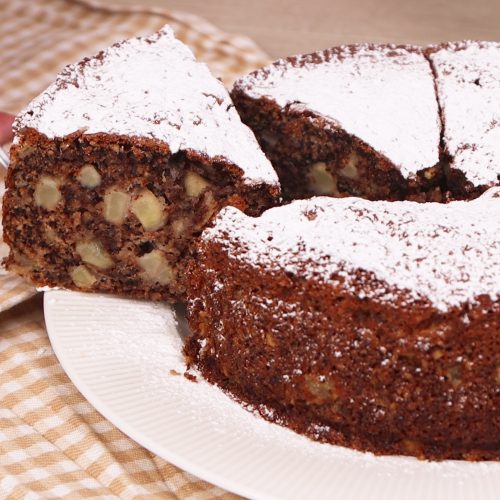
Apple Walnut Cake with Whipped Egg Whites
Instructions
- Preheat the oven to 180°C conventional heat. Grease a 20 cm round pan and line the bottom with baking parchment.
- Peel, core, and cut the apples into 1–1.5 cm pieces.
- Toss the apples with 10–15 ml lemon juice.
- Pulse the walnuts in a food processor until finely ground, but do not process into a paste.
- In a bowl, combine flour, baking powder, baking soda, half the salt, and ground walnuts.
- Separate the eggs carefully.
- Whisk egg yolks with granulated sugar and vanilla sugar until smooth and slightly lighter.
- Beat the egg whites with the remaining salt until soft peaks form.
- Add the apples to the flour-walnut mixture and toss well.
- Add the yolk-sugar mixture and stir. The batter will be very thick.
- Stir about one quarter of the whipped egg whites into the thick batter to loosen it.
- Fold in the remaining egg whites in two additions, working gently.
- Transfer the batter to the prepared 20 cm pan and smooth the top.
- Bake at 180°C for 40–45 minutes.
- If the surface becomes too dark after 30–35 minutes, loosely cover it.
- Check the center with a wooden skewer. A few moist crumbs are fine, but there should be no raw batter.
- Cool in the pan for 15–20 minutes.
- Remove carefully and cool completely on a wire rack before slicing.