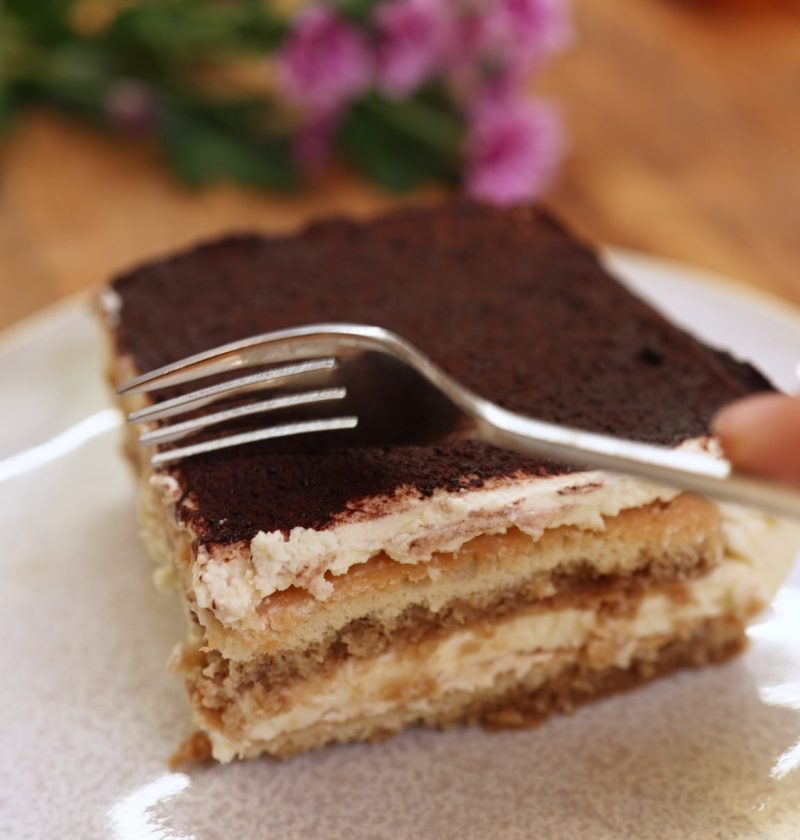
This creamy tiramisu is rich, smooth, coffee-soaked, and wonderfully simple to prepare. It has all the elements you want from a classic-style tiramisu: soft ladyfingers, strong coffee, a thick mascarpone cream, and a delicate layer of cocoa powder on top.
This particular version is eggless, which makes the preparation especially straightforward. Instead of making a traditional egg-based mascarpone cream, we combine mascarpone with cold whipping cream and powdered sugar. The result is light, stable, creamy, and ideal for beginners.
The two most important secrets are simple: keep the cream very cold and do not soak the ladyfingers for too long. I’ll explain exactly how to do both so your tiramisu holds its shape and slices beautifully.
Recommended Dish Size
Use a rectangular dish approximately 20 × 25 cm.
A slightly smaller dish will produce a taller tiramisu, while a larger dish will give you thinner layers.
How to Make Creamy Tiramisu Step by Step
Step 1: Chill the Mixing Bowl and Beaters
Place your mixing bowl and mixer beaters in the refrigerator for about 10 minutes before you begin.
Keep the whipping cream refrigerated until the moment you need it.
This may seem like an unnecessary extra step, but temperature is extremely important when whipping cream.
Cold cream contains fat that can trap air efficiently. If the cream becomes too warm, it may stay loose instead of becoming thick and fluffy.
Chef’s secret: A metal bowl works particularly well because it becomes cold quickly and stays cold longer than many plastic bowls.
If your kitchen is very warm, you can place the bowl in the freezer for about 5 minutes instead.
Step 2: Brew Strong Coffee
Prepare approximately 300 ml strong coffee.
Espresso-style coffee works particularly well because the flavour needs to remain noticeable after it is absorbed by the biscuits and combined with the mascarpone cream.
Pour the coffee into a shallow bowl and allow it to cool completely to room temperature.
Do not use hot coffee.
Hot coffee softens ladyfingers almost immediately and can also warm the mascarpone layer during assembly.
Chef’s tip: Prepare the coffee before making the cream. By the time your mascarpone mixture is ready, the coffee should be cool enough to use.
If adding coffee liqueur or Marsala, stir it into the coffee only after the coffee has cooled.
Step 3: Prepare Your Work Area
Place the following items close together:
- cooled coffee
- ladyfingers
- serving dish
- mascarpone cream ingredients
- spatula
Tiramisu assembly is easier when everything is within reach.
Once you begin dipping the biscuits, you want to work steadily so each ladyfinger absorbs approximately the same amount of coffee.
Chef’s secret: Arrange the ladyfingers roughly in the shape of your dish before dipping them. This lets you see how many you need and where some may need trimming.
Step 4: Start the Mascarpone Cream
Place 500 g cold mascarpone in the chilled mixing bowl.
Add 25–30 g powdered sugar.
Mix briefly on low speed, just until the mascarpone softens slightly and the sugar begins to incorporate.
Do not beat mascarpone aggressively at this stage.
Why? Mascarpone contains a high percentage of fat and can become grainy if it is overworked.
Beginner tip: If the mascarpone looks very firm straight from the refrigerator, that is completely normal.
Step 5: Add the Cold Whipping Cream
Pour in 500 ml very cold heavy whipping cream.
Begin beating on low speed for about 20–30 seconds.
Then increase to medium speed.
Continue until the mixture becomes noticeably thicker and holds soft-to-medium peaks.
The finished cream should be fluffy, thick, and spreadable.
When you lift the beaters, the cream should form a peak that holds its shape.
Chef’s secret: Stop mixing as soon as the cream is thick enough. Overbeating can cause the mixture to become grainy or begin separating.
Do not walk away from the mixer during the final minute. The difference between perfectly whipped and overwhipped cream can be very short.
Step 6: Check the Cream Consistency
Take a spoonful of cream and turn the spoon slightly.
The mixture should stay in place instead of running off.
However, it should still look smooth and creamy rather than stiff and buttery.
If the mixture is still too loose, beat for another 10–15 seconds, then check again.
Chef’s rule: Short bursts are much safer than beating continuously once the cream has started thickening.
Step 7: Prepare the Ladyfingers for Dipping
Pour your completely cooled coffee into a wide, shallow bowl.
Take one ladyfinger at a time.
Dip it very quickly into the coffee.
A fast in-and-out motion is enough.
You usually need no more than about one second per side.
This is one of the most important steps in the entire recipe.
Ladyfingers absorb liquid very quickly. If you leave them sitting in the coffee, they can collapse and produce a watery tiramisu.
Chef’s secret: The centre of the biscuit should still feel slightly firm when it goes into the dish. During chilling, the moisture spreads through the biscuit and softens it perfectly.
Step 8: Build the First Biscuit Layer
Arrange the dipped ladyfingers tightly across the bottom of the serving dish.
Place them side by side with as few gaps as possible.
If necessary, break or cut a ladyfinger to fill small spaces around the edges.
Why tight placement matters: A compact biscuit layer creates better structure and gives you cleaner slices later.
Try to keep all the ladyfingers running in the same direction for a neat appearance.
Step 9: Add the First Cream Layer
Spoon approximately half of the mascarpone cream over the ladyfingers.
Spread it gently from the centre toward the edges.
An offset spatula is especially useful, but the back of a spoon also works.
Try to create a level layer.
Chef’s tip: Do not press down hard while spreading. The coffee-soaked biscuits underneath are delicate.
Aim for an even layer from edge to edge.
Step 10: Add the Second Ladyfinger Layer
Dip another batch of ladyfingers quickly into the coffee.
Arrange them over the mascarpone layer.
Again, keep them close together.
Chef’s secret: You can position the second layer in the opposite direction to the first. This can give the finished tiramisu slightly more stability when slicing.
However, this is optional.
Step 11: Add the Final Mascarpone Layer
Spread the remaining mascarpone cream over the second biscuit layer.
Smooth the top carefully.
For a rustic homemade tiramisu, slight waves in the cream look beautiful.
For a more elegant café-style appearance, use an offset spatula to make the surface completely level.
You can also pipe the final cream layer using a piping bag if you want a decorative finish.
Step 12: Cover and Refrigerate
Cover the dish carefully.
Refrigerate for at least 4 hours.
For the best result, leave the tiramisu in the refrigerator overnight, approximately 8–12 hours.
This resting time is not merely for chilling.
It allows the coffee to distribute through the ladyfingers, the mascarpone cream to firm, and all the flavours to come together.
Chef’s secret: Tiramisu made the day before serving is usually noticeably better than tiramisu served after only an hour or two.
Step 13: Dust with Cocoa Powder
Do not add the cocoa too early if you want a neat, dry-looking finish.
Just before serving, place 10–15 g unsweetened cocoa powder in a small sieve.
Dust it evenly over the entire surface.
Use a light layer rather than a very thick one.
Chef’s tip: Too much cocoa can dominate the delicate mascarpone flavour and make each bite taste unnecessarily bitter.
Step 14: Slice Cleanly
Use a sharp knife or thin serving spatula.
For very clean portions, wipe the knife between each cut.
Cut the tiramisu while it is still thoroughly chilled.
Chef’s secret: The colder the tiramisu is, the cleaner the slices will be.
Step 15: Serve
Serve the tiramisu directly from the refrigerator.
For decoration, you can add:
- a little extra cocoa
- finely grated dark chocolate
- chocolate curls
- coffee beans
- a small piece of dark chocolate
The dessert should feel creamy and soft while still holding clear layers.
Chef’s Best Tips
Keep everything cold. Cold cream, mascarpone, bowl, and beaters give you the most stable filling.
Do not overbeat mascarpone. Excessive mixing can make it grainy or cause separation.
Use strong coffee. Mild coffee can disappear beneath the rich mascarpone flavour.
Cool the coffee completely. Warm coffee makes the biscuits soften too quickly.
Dip the ladyfingers quickly. Do not soak them.
Keep the biscuit layers tight. Fewer gaps mean better structure and cleaner slices.
Make even cream layers. Consistent layers give the finished dessert a more attractive appearance.
Chill for at least 4 hours. Overnight is even better.
Add cocoa shortly before serving. This prevents it from absorbing moisture and becoming dark and patchy.
Use good mascarpone. Since mascarpone is the main flavour of the cream, quality makes a noticeable difference.
Storage
Keep tiramisu covered in the refrigerator.
It is best eaten within 2–3 days.
Because this recipe contains fresh mascarpone and cream, do not leave it at room temperature for extended periods.
Take it out of the refrigerator only shortly before serving.
Can Tiramisu Be Frozen?
Yes, although the texture can change slightly.
Freeze the assembled tiramisu without the final cocoa layer.
Wrap it tightly and freeze for up to 1 month.
Defrost overnight in the refrigerator, then dust with fresh cocoa just before serving.
Nutrition
Approximate nutritional values per serving, based on 10 servings and approximately 225 g ladyfingers:
- Calories: approximately 450 kcal
- Protein: approximately 7 g
- Carbohydrates: approximately 31 g
- Fat: approximately 33 g
- Saturated Fat: approximately 21 g
- Fibre: approximately 1 g
- Sugars: approximately 17 g
- Salt: approximately 0.2 g
These values are estimates. Exact nutrition will vary depending on the mascarpone, whipping cream, ladyfinger brand, amount of powdered sugar, and optional alcohol or chocolate used.
FAQ – Frequently Asked Questions
Does This Tiramisu Contain Raw Eggs?
No.
This version is made with mascarpone, whipping cream, and powdered sugar and does not use eggs.
That also makes the cream particularly simple to prepare.
What Kind of Coffee Should I Use?
Strong espresso or strong brewed coffee works best.
The coffee flavour should be intense enough to remain noticeable once combined with the mascarpone cream.
Does the Coffee Need to Be Completely Cold?
Yes.
Warm coffee can oversoften the ladyfingers and warm the cream during assembly.
Always let it cool to room temperature first.
How Long Should I Dip the Ladyfingers?
Very briefly.
One quick dip is usually enough.
The ladyfingers should absorb coffee on the outside but should not become completely saturated before going into the dish.
Why Is My Tiramisu Watery?
The most common reasons are:
- the ladyfingers were soaked for too long
- the coffee was still warm
- the cream was not whipped enough
- the tiramisu was not chilled long enough
- the mascarpone cream became overmixed and separated
Why Did My Mascarpone Cream Become Grainy?
It was probably beaten for too long or at too high a speed.
Once the cream reaches thick peaks, stop mixing immediately.
Can I Reduce the Sugar?
Yes.
This recipe is already relatively lightly sweetened, but you can reduce the powdered sugar slightly if your ladyfingers are particularly sweet.
Can I Add Alcohol?
Yes.
For an adult version, add approximately 15–30 ml Marsala, amaretto, rum, or coffee liqueur to the cooled coffee.
Can I Make It Alcohol-Free?
Absolutely.
Simply use strong coffee without any alcohol.
Can I Use Decaffeinated Coffee?
Yes.
Decaffeinated espresso or strong decaf coffee works perfectly.
Can I Make Tiramisu the Day Before?
Yes, and I actually recommend it.
An overnight rest gives the ladyfingers time to soften evenly and allows the cream to become more stable.
How Long Does Tiramisu Need to Chill?
At least 4 hours.
For the best texture, chill it for 8–12 hours.
Can I Use Whipped Cream Without Mascarpone?
Technically you can make a layered coffee dessert that way, but it will not have the same rich texture or characteristic mascarpone flavour.
Can I Replace Mascarpone?
A mixture of full-fat cream cheese and whipping cream can work in an emergency, but the flavour will be different.
For the most authentic creamy result, mascarpone is strongly recommended.
Can I Add Chocolate Between the Layers?
Yes.
Finely grated dark chocolate between the cream layers works very well.
Use approximately 20–30 g so it does not overpower the coffee and mascarpone.
Why Should Cocoa Be Added Just Before Serving?
Cocoa absorbs moisture from the cream.
If added many hours in advance, it can become very dark and damp-looking.
Adding it shortly before serving gives a fresher, more elegant finish.
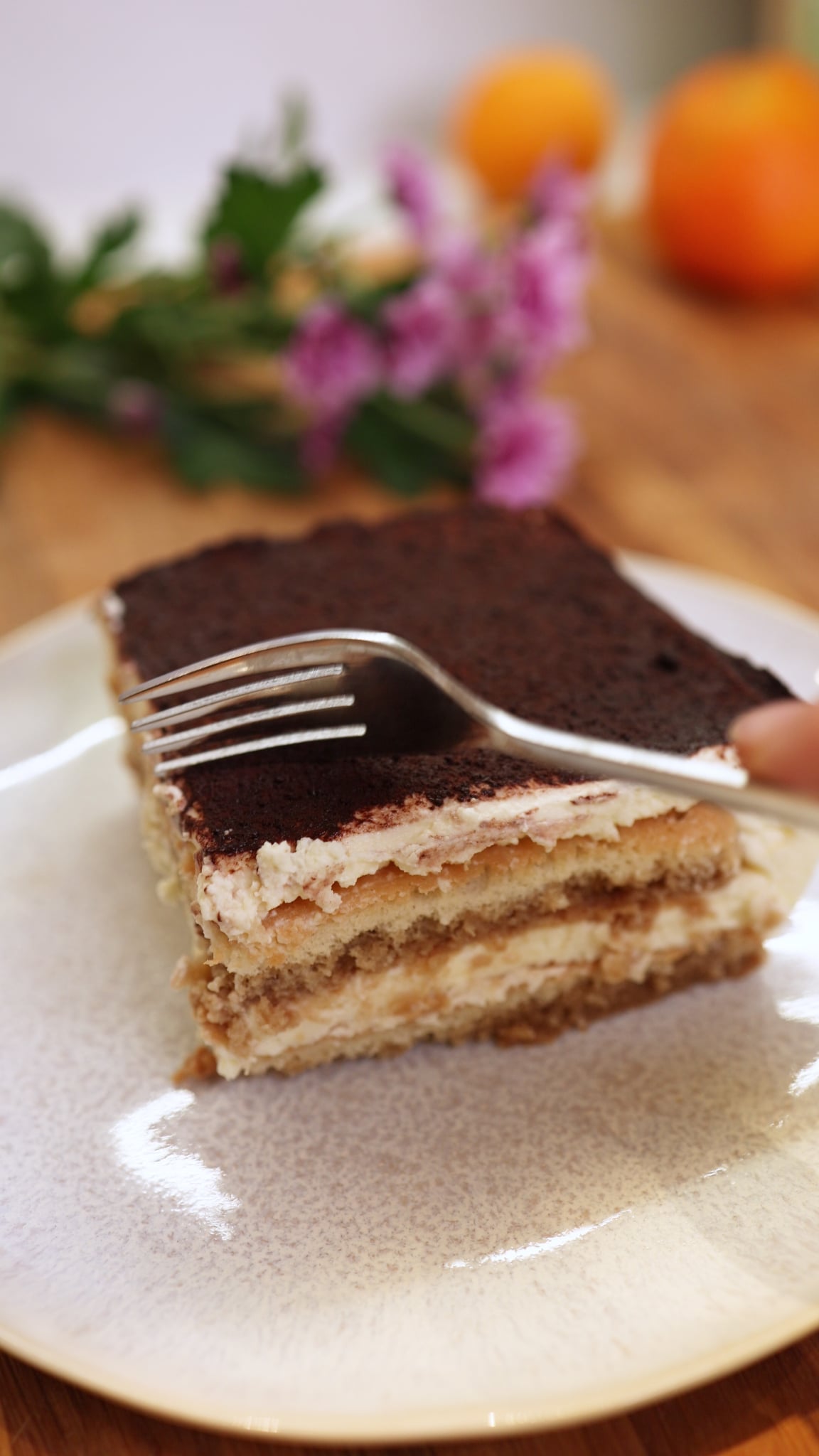
Creamy Classic Tiramisu
Instructions
- Chill the mixing bowl and beaters for 10 minutes.
- Brew approximately 300 ml strong coffee and allow it to cool completely.
- Place mascarpone and powdered sugar in the chilled bowl and mix briefly.
- Add the cold whipping cream and beat until thick, smooth peaks form. Do not overbeat.
- Quickly dip each ladyfinger into the cooled coffee.
- Arrange a tight layer of dipped ladyfingers in a 20 × 25 cm dish.
- Spread half of the mascarpone cream evenly over the biscuits.
- Add a second layer of quickly dipped ladyfingers.
- Spread the remaining mascarpone cream over the top and smooth the surface.
- Cover and refrigerate for at least 4 hours, preferably overnight.
- Dust with unsweetened cocoa powder immediately before serving.
- Slice while thoroughly chilled and serve.