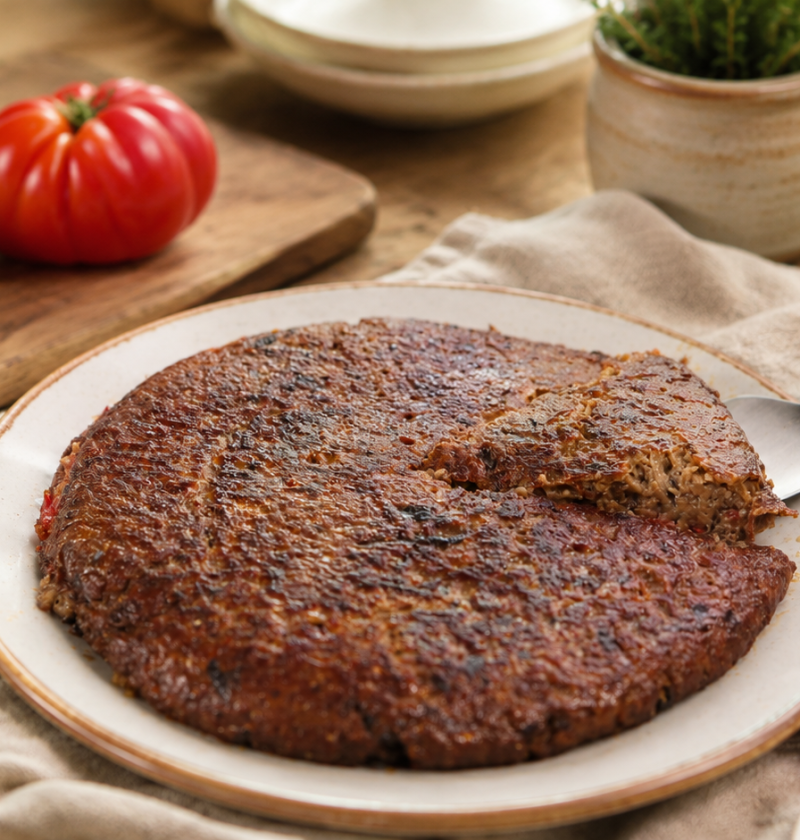
This savoury eggplant skillet cake is simple, budget-friendly, and surprisingly satisfying. Soft eggplant is combined with eggs, flour, herbs, and black pepper, then cooked slowly in a covered pan until golden on both sides. A separate tomato, onion, garlic, and pepper mixture adds sweetness, acidity, and depth of flavour. The key to getting the texture right is removing excess moisture from the eggplant before mixing the batter. If you skip that step, the mixture can become watery and difficult to flip. I’ll explain each stage carefully so even a complete beginner can follow it confidently. Savoury eggplant skillet cake is one of those dishes that looks impressive on the table yet is built from very simple, honest ingredients, making it perfect for someone who is still learning to cook but wants results that feel restaurant‑worthy. Here, grated eggplant is transformed into a tender, sliceable savoury cake, gently seasoned with dried basil, oregano and black pepper, then bound with eggs and a little flour so it holds together beautifully in the pan. The salting and draining step removes excess moisture and any harsh notes, allowing the eggplant to become soft and delicate rather than watery or bland. Alongside the skillet cake, you prepare a bright tomato and vegetable mixture with onion, garlic, bell pepper and ripe tomatoes, simmered until thick and fragrant so it can be spooned generously over each slice.
🍆 Discover How A Simple Eggplant Becomes A Golden Skillet Cake That Feels Comforting And Elegantly Refined
⏱️ Quick Overview
- Prep Time: 25 minutes
- Cook Time: 35–40 minutes
- Total Time: 1 hour 5 minutes
- Servings: 4
- Difficulty: Medium
- Category: Savoury Main, Vegetarian Skillet Dish
- Cuisine: Modern European Home‑Style
- Calories: Approximately 320 kcal per serving
🍅 Enjoy Each Slice Topped With A Bright Tomato And Pepper Mixture That Brings Colour And Freshness To Your Plate
⭐ Why You’ll Love This Recipe
- Elegant Yet Homely: This skillet cake looks like a refined restaurant dish while still feeling warm, comforting and suitable for everyday meals.
- Eggplant Reimagined: Grated eggplant becomes a tender, sliceable cake, showing you a new way to enjoy this vegetable beyond simple frying or baking.
- Balanced Flavour Layers: The soft, herbed eggplant base and the bright tomato and pepper topping create a satisfying contrast of textures and tastes.
- Clear, Calm Guidance: Each step is explained in detail, making the process accessible even if you have never cooked a savoury cake or flipped one in a pan before.
- Simple Ingredients, Big Impact: With eggs, flour, herbs and basic vegetables, you achieve a dish that feels far more luxurious than its modest components suggest.
- Pan‑Only Cooking: The recipe relies on a non‑stick pan and a few basic tools, so you do not need special equipment or an oven to succeed.
- Versatile Serving Options: You can serve the skillet cake as a main course with salad, as a light supper with bread or even as a brunch dish for guests.
🌿 Let Dried Basil And Oregano Gently Lift The Flavour Of Both The Cake And The Topping Into Something Truly Memorable
🍽️ Kitchen Tools and 🛠️ Equipment Needed 🔪
- 🧀 Box grater for grating the eggplant into fine shreds
- 🥣 Large mixing bowl for salting and mixing the eggplant batter
- 🚿 Sieve or colander for draining and squeezing excess liquid from the eggplant
- 🔪 Sharp knife and cutting board for chopping onion, garlic, bell pepper and tomatoes
- 🍳 Non‑stick frying pan for cooking the skillet cakes and tomato mixture
- 🥄 Wooden spoon or spatula for stirring and spreading the batter in the pan
- 🍽️ Large plate for flipping the skillet cake safely and cleanly
- 🥄 Measuring spoons for accurately weighing salt, sugar and dried herbs
- 🧴 Small jug or bowl for cracking and mixing the eggs if preferred
Trust This Calm, Step‑By‑Step Method To Guide You Through Salting, Mixing And Flipping With Growing Confidence
👨🍳 How to Make Savoury Eggplant Skillet Cake
Step 1: Prepare the Eggplants
Wash the eggplants and dry them.
Trim off the stems, then grate the eggplants using the coarse side of a box grater.
You can leave the skin on if the eggplants are young and tender.
Place the grated eggplant in a large bowl and sprinkle with about 5 g salt.
Mix thoroughly so the salt is evenly distributed.
Leave it to stand for 10 minutes.
Why this matters: Eggplant holds a surprising amount of water. The salt draws out some of that moisture, which gives the finished skillet cake a firmer texture.
Chef’s tip: Do not leave the salted eggplant for much longer than 15–20 minutes, or it may become overly soft.
Turn Your Everyday Non‑Stick Pan Into A Stage For A Savoury Cake That Looks Ready For A Restaurant Menu
Step 2: Remove Excess Moisture
After 10 minutes, transfer the eggplant to a colander.
Press it firmly with your hands to remove as much liquid as possible.
For the best result, place the eggplant inside a clean kitchen towel and squeeze gently but firmly.
You should remove a noticeable amount of liquid.
Chef’s secret: This is one of the most important steps in the recipe. The drier the grated eggplant is, the easier the mixture will be to cook and flip.
Do not rinse the eggplant after salting unless you have used a very large amount of salt.
Serve Generous Wedges Of Eggplant Cake And Watch The Tomato Sauce Settle Around Them Like A Warm, Flavourful Blanket
Step 3: Chop the Onion
Peel the onion and cut it into small cubes.
Try to keep the pieces relatively even so they cook at the same speed.
Heat 15 ml olive oil in a frying pan over medium heat.
Add the onion and cook for about 2–3 minutes, stirring occasionally.
The onion should become soft and slightly translucent.
Chef’s tip: You are not looking for deep browning here. Gentle cooking gives a sweeter, softer flavour.
✨ Take A Moment To Appreciate The Aroma Of Herbs, Garlic And Tomatoes As They Simmer Into A Rich, Gentle Topping
Step 4: Add Garlic
Peel and finely chop the garlic cloves.
Add them to the onion and cook for about 30 seconds.
Stir constantly.
Garlic burns quickly, so do not leave it unattended.
Chef’s secret: Add garlic only after the onion has softened. If garlic goes in too early, it can become bitter before the onion is ready.
🍽️ Bring This Dish To The Table And Let It Become The Centrepiece Of A Relaxed Supper Shared With People You Care About
Step 5: Add the Bell Pepper
Remove the stem, seeds, and white membranes from the bell pepper.
Cut it into small cubes or thin strips.
Add it to the pan.
Cook for another 3–4 minutes, stirring from time to time.
The pepper should soften slightly but still retain some structure.
🔥 Feel The Quiet Satisfaction Of Flipping A Perfectly Set Skillet Cake And Seeing Its Golden Surface For The First Time
Step 6: Add the Tomatoes
Cut the tomatoes into small cubes.
Add them to the pan with:
- salt
- black pepper
- 4 g sugar
- 2 g dried oregano
- 2 g dried basil
Mix everything well.
Cook uncovered for about 5–7 minutes, or until the tomatoes soften and the mixture becomes thick rather than watery.
Why add sugar? A small amount helps balance the natural acidity of the tomatoes.
Chef’s tip: If your tomatoes are very ripe and naturally sweet, you can reduce or omit the sugar.
💚 Choose This Recipe When You Want A Vegetarian Main That Still Feels Hearty, Structured And Deeply Satisfying
Step 7: Reduce the Tomato Mixture Properly
Continue cooking until most of the excess liquid has evaporated.
The mixture should be moist but not soupy.
This is important because too much liquid can make the finished dish soggy.
Chef’s secret: Drag your spatula across the bottom of the pan. If the liquid immediately floods back into the space, cook a little longer.
Once ready, remove the tomato mixture from the heat and set aside.
🌈 Enjoy The Contrast Between The Soft Interior Of The Cake And The Lively, Textured Tomato And Pepper Mixture On Top
Step 8: Make the Eggplant Batter
Place the well-drained grated eggplant in a clean bowl.
Add:
- 2 eggs
- black pepper
- 2 g dried basil
- 2 g dried oregano
- 30 g all-purpose flour
Mix until everything is evenly combined.
The mixture should be moist and cohesive but not runny.
Chef’s tip: Let the mixture stand for 2–3 minutes after adding the flour. The flour will absorb some remaining moisture.
If it is still very wet, add another 5–10 g flour.
Avoid adding too much, because the goal is a tender eggplant texture rather than a dense pancake.
🧂 Appreciate How A Thoughtful Balance Of Salt, Sugar And Herbs Creates A Flavour That Is Rounded Rather Than Overwhelming
Step 9: Heat the Pan
Wipe out the frying pan if necessary.
Add 10–15 ml olive oil and heat over medium-low heat.
The pan should be hot but not smoking.
Chef’s secret: Medium-low heat is essential. The eggplant mixture is thick and needs time to cook through without burning on the outside.
🍞 Pair Each Slice With Bread Or Salad And Turn A Simple Meal Into A Gentle, Comforting Experience At Home
Step 10: Add Half of the Eggplant Batter
Spoon half of the eggplant mixture into the pan.
Spread it into an even layer with a spatula.
Aim for a thickness of about 1.5–2 cm.
Smooth the edges so the cake is easier to flip later.
Beginner tip: Do not make the layer too thick. A thinner layer cooks more evenly and is much easier to turn.
🌿 Use This Recipe As A Way To Learn About Moisture Control And Texture, Skills That Will Serve You In Many Other Dishes
Step 11: Cover and Cook
Cover the pan with a lid.
Cook over low heat for about 10 minutes.
The lid traps steam and helps the centre set while the bottom becomes golden.
Do not keep lifting the lid.
After about 8 minutes, you can check the underside gently with a spatula.
What to look for: The bottom should be golden and the top should look mostly set rather than wet.
🍆 Return To This Savoury Eggplant Skillet Cake Whenever You Need A Reliable, Warm Dish That Still Feels Special
Step 12: Flip Carefully
Place a large flat plate over the pan.
Hold the plate firmly and carefully turn the pan upside down so the eggplant cake lands on the plate.
Add a little more oil to the pan if needed.
Then slide the cake back into the pan with the uncooked side facing down.
Chef’s tip: A plate is much safer than trying to flip a large eggplant cake with a spatula.
🍅 Invite Friends To Taste Your Herbed Tomato Topping And Show Them How Much Flavour Can Come From Basic Ingredients
Step 13: Cook the Second Side
Cover again and cook for another 8–10 minutes over low heat.
The second side should become golden and the centre should feel firm.
If necessary, cook uncovered for the final 1–2 minutes to crisp the surface slightly.
Step 14: Repeat with the Remaining Batter
Transfer the first cooked eggplant cake to a plate.
Add a little more oil to the pan and repeat the process with the remaining half of the batter.
Cook approximately 10 minutes on the first side and 8–10 minutes on the second side.
✨ Let The Golden Colour Of The Cake And The Red And Green Of The Topping Bring Visual Warmth To Your Table
Step 15: Serve with the Tomato Mixture
Serve the eggplant skillet cakes warm.
Spoon the tomato, onion, garlic, and pepper mixture over the top or serve it alongside.
You can also finish the dish with:
- chopped parsley
- fresh basil
- a spoonful of Greek yoghurt
- crumbled feta
- a squeeze of lemon juice
Celebrate The Moment When You Cut Into The Cake And See How Soft Eggplant And Eggs Have Set Into A Gentle, Cohesive Slice
👨🍳 Chef’s Best Tips
Salt the eggplant first. This improves the texture and helps remove excess water.
Squeeze thoroughly. Wet eggplant batter is much harder to cook and flip.
Cook the tomato mixture until thick. A watery sauce will make the final dish soggy.
Use medium-low heat. High heat can burn the outside while the middle remains undercooked.
Cook with a lid. This helps the centre set through gentle steam.
Divide the batter into two portions. Smaller cakes are much easier to flip than one very large one.
Use a plate to flip. It gives you much more control.
Do not overdo the flour. Too much flour makes the texture heavy.
Fresh herbs can be added at the end. They give the dish a brighter flavour.
Keep This Recipe In Your Personal Collection As A Confident Step Into The World Of Savoury Cakes And Skillet Cooking
📅 Nutrition Per Serving (entire recipe: 4 portions)
- Serving Size (g): 220
- Calories (kcal): 320
- Carbohydrates (g): 20
- Protein (g): 11
- Fat (g): 21
- Saturated Fat (g): 4
- Polyunsaturated Fat (g): 4
- Monounsaturated Fat (g): 12
- Trans Fat (g): 0
- Cholesterol (mg): 95
- Sodium (mg): 520
- Potassium (mg): 680
- Fibre (g): 6
- Sugar (g): 10
- Vitamin A (IU): 2100
- Vitamin C (mg): 38
- Calcium (mg): 80
- Iron (mg): 2.3
Nutritional values are estimates and will vary depending on the size of the eggplants, amount of oil used, and exact vegetable quantities.
❓ FAQ
Do I need to peel the eggplant?
No.
Young eggplants have tender skin, so you can leave it on.
If the skin feels particularly thick or tough, you can peel part or all of it.
Why do I need to salt the eggplant?
Salting helps draw out excess moisture.
That gives the batter better structure and makes it easier to cook.
Can I skip squeezing the eggplant?
I do not recommend it.
If too much water remains, the batter can become loose and the finished cake may fall apart.
Can I use courgette instead?
Yes.
Courgette works well, but it contains even more water.
Salt it and squeeze it very thoroughly before mixing with the eggs and flour.
Can I use a different flour?
Yes.
You can use:
— whole wheat flour
— oat flour
— chickpea flour
Keep in mind that each flour absorbs moisture differently, so the amount may need a small adjustment.
Can I make this gluten-free?
Yes.
Use a suitable gluten-free flour blend or chickpea flour.
Add it gradually until the mixture holds together.
Why does my eggplant cake fall apart?
The most common reasons are:
— too much moisture in the eggplant
— too little flour
— the first side was not cooked long enough
— the cake was flipped too early
— the layer was too thick
Wait until the top is mostly set before flipping.
Can I add cheese?
Yes.
You can add about 50–80 g grated cheese such as mozzarella, cheddar, Gouda, or Parmesan to the eggplant batter.
Can I bake it instead of frying?
Yes.
Spread the mixture in a parchment-lined baking dish and bake at 190°C for about 25–35 minutes, depending on thickness.
For more browning, finish under the grill for 2–3 minutes.
Can I prepare it in advance?
Yes.
You can prepare the tomato mixture several hours ahead.
The eggplant batter is best cooked soon after mixing because the vegetables continue releasing moisture.
How should I store leftovers?
Store leftovers in an airtight container in the refrigerator for up to 2–3 days.
Reheat gently in a frying pan or in the oven.
What can I serve with this dish?
It works well with:
— green salad
— yoghurt-garlic sauce
— feta
— fresh herbs
— crusty bread
— roasted potatoes
Enjoy Every Bite As A Reminder That With Patience, Care And Simple Tools, You Can create Food That Truly Nourishes And Comforts
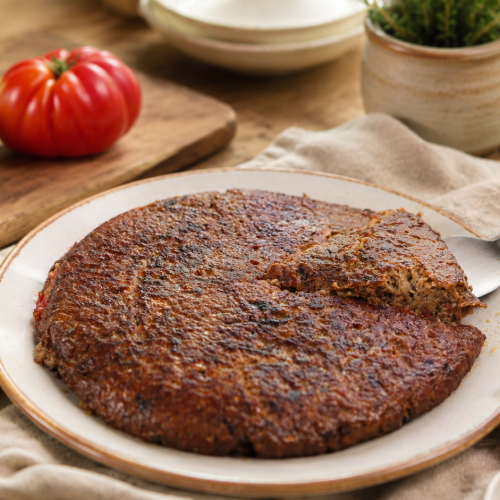
Savoury Eggplant Skillet Cake with Tomato and Herbs
Instructions
- Grate the eggplant, mix with 5 g salt, and leave for 10 minutes.
- Squeeze out as much excess liquid as possible.
- Fry the chopped onion in olive oil for 2–3 minutes.
- Add garlic and bell pepper and cook for another 3–4 minutes.
- Add tomatoes, salt, pepper, sugar, oregano, and basil. Cook for 5–7 minutes until thick.
- Mix the drained eggplant with eggs, black pepper, basil, oregano, and flour.
- Heat a little olive oil in a non-stick pan.
- Add half of the eggplant batter and spread evenly.
- Cover and cook over low heat for 10 minutes.
- Flip carefully using a large plate and cook for another 8–10 minutes.
- Repeat with the remaining batter.
- Serve warm with the tomato and vegetable mixture.