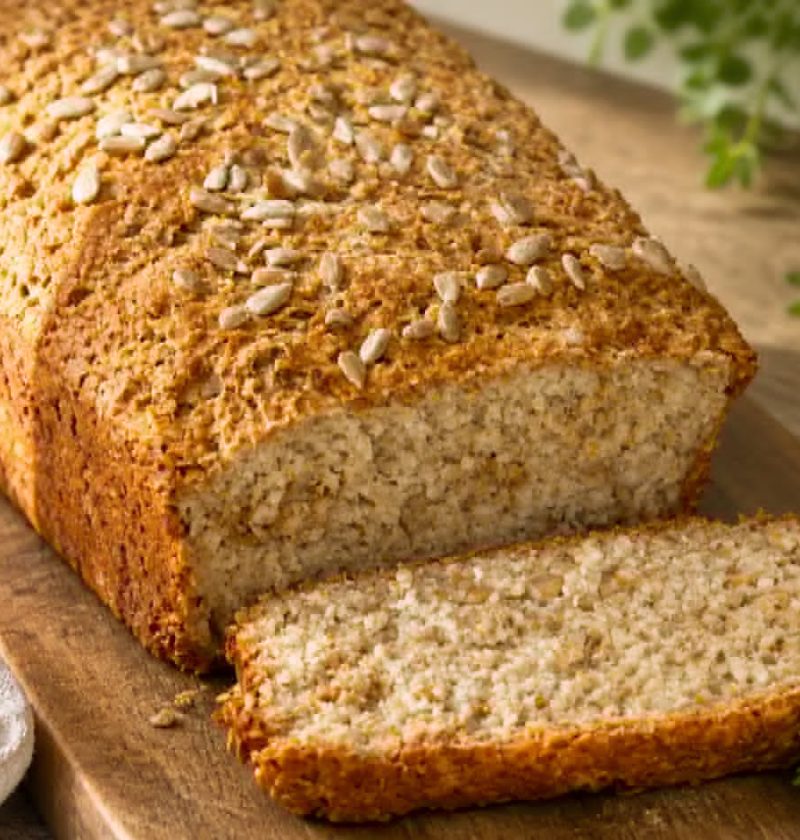
This rustic yogurt oat hearth loaf is the kind of bread that makes your kitchen smell like a country bakery with almost no effort. You start with a single tub of natural yogurt, a beaten egg, a generous amount of oats and a little baking powder, and somehow they transform into a golden, wholesome loaf. The texture is wonderfully hearty yet tender, with a gentle chew from the oats and a soft crumb thanks to the yogurt and egg. There is no yeast to worry about, no kneading for long stretches and no complicated shaping, which makes this recipe perfect if you are new to bread baking. The two‑stage baking—first at a higher temperature, then lower—helps the loaf rise, set and dry out just enough to slice cleanly without becoming dry. A hint of salt balances the natural tang of the yogurt and the nutty flavour of the oats, giving you a loaf that works just as well with sweet toppings as it does with savoury ones. You can toast it, spread it with butter, layer it with cheese or enjoy it simply with a drizzle of honey. Because the ingredient list is so short and honest, this bread feels like something you could bake every week without fuss. Once you have made it once, you will see how easily it can become your go‑to recipe for a simple, nourishing loaf that fits into busy days and calm weekends alike.
🌾 Enjoy A Warm Slice Of Yogurt Oat Bread That Feels Comforting, Honest And Beautifully Simple
⏱️ Quick Overview
Prep Time: 10–15 minutes
Cook Time: 60 minutes (30 minutes at 180°C, then 30 minutes at 150°C)
Total Time: 1 hour 15 minutes
Servings: 10 slices
Difficulty: Easy
Category: Bread / Breakfast / Snack
Cuisine: Modern Home‑Style, Oat Bread
Calories: ~150 kcal per serving
🥛 Savour A Loaf Where Natural Yogurt And Oats Come Together In A Soft, Hearty Crumb
⭐ Why You’ll Love This Recipe
- Minimal Ingredients, Maximum Comfort: You only need yogurt, oats, an egg, baking powder and salt to create a satisfying loaf.
- No Yeast, No Waiting: There is no proving time, so you can mix, bake and enjoy without planning hours ahead.
- Hearty Yet Tender Texture: The oats give a pleasant chew while the yogurt and egg keep the crumb soft and moist.
- Naturally Versatile Flavour: The gentle tang of yogurt and nutty oats pairs beautifully with both sweet and savoury toppings.
- Beginner‑Friendly Method: The batter‑style dough is simply stirred together and poured into a tin, making it ideal for new bakers.
- Great For Meal Prep: The loaf slices well and keeps nicely, so you can bake once and enjoy it over several days.
- Wholesome Everyday Option: With oats and yogurt at its core, this bread feels nourishing without being heavy or complicated.
🍞 Start Your Morning With A Slice Of Golden Oat Bread That Toasts To Perfection
📅 Nutrition Per Serving (entire recipe, 10 servings)
For the whole loaf:
- Calories: ~1,510 kcal
- Protein: ~70 g
- Fat: ~41 g
- Carbohydrates: ~215 g
- Fibre: ~18 g
- Sugars: ~25 g
Per serving (1 slice out of 10):
- Calories: ~150–155 kcal
- Protein: ~7 g
- Fat: ~4 g
- Carbohydrates: ~21–22 g
- Fibre: ~2 g
- Sugars: ~2–3 g
(Values are approximate and based on natural yogurt and standard rolled oats.)
✨ Choose A No‑Yeast Loaf That Still Delivers The Pleasure Of Freshly Baked Bread At Home
👨🍳 DETAILED STEP‑BY‑STEP RECIPE (Chef‑Level Instructions)
Step 1: Prepare The Tin And Oven
Lightly grease a standard loaf tin and, if you like, line it with baking parchment to make removing the loaf easier, then preheat your oven to 180°C / 350°F / Gas mark 4.
💡 Preparing the tin before you start mixing means you can transfer the batter straight in without it sitting and thickening unnecessarily.
Step 2: Measure The Yogurt
Spoon the entire 500 ml tub of natural yogurt into a large mixing bowl, making sure to scrape out every bit so your measurements stay accurate.
💡 If the yogurt has separated slightly, give it a quick stir in the tub before adding it to the bowl to ensure an even texture.
🌿 Let The Gentle Tang Of Yogurt Lift The Nutty Flavour Of Oats In Every Bite
Step 3: Add The Beaten Egg
Beat the egg lightly in a small bowl or jug, then pour it into the yogurt and whisk them together until the mixture looks smooth and uniform.
💡 Mixing the egg thoroughly into the yogurt at this stage helps it distribute evenly through the loaf, giving a consistent texture.
Step 4: Combine The Dry Ingredients
In a separate bowl, add the oats, baking powder and salt, stirring well so the baking powder and salt are evenly dispersed among the oats.
💡 Mixing the dry ingredients together first prevents pockets of baking powder or salt from forming in the finished loaf.
🔥 Bake Once And Enjoy A Week Of Wholesome Slices Ready For Sweet Or Savoury Toppings
Step 5: Bring Wet And Dry Together
Tip the oat mixture into the bowl with the yogurt and egg, then stir slowly with a spatula or wooden spoon until everything is just combined and no dry patches remain.
💡 Work gently and stop as soon as the oats are fully moistened; over‑mixing can make the loaf denser than necessary.
Step 6: Check The Consistency
Look at the mixture to ensure it is thick but spoonable, more like a heavy batter than a traditional bread dough, and let it sit for a couple of minutes so the oats begin to absorb the liquid.
💡 Allowing the mixture to rest briefly helps the oats swell slightly, which improves the final texture and helps the loaf hold its shape.
🥣 Turn A Single Tub Of Yogurt And A Bowl Of Oats Into A Rustic Bakery‑Style Loaf
Step 7: Fill The Loaf Tin
Pour or spoon the mixture into the prepared loaf tin, smoothing the top with the back of a spoon or spatula so it is level and reaches into the corners.
💡 A smooth, even surface helps the loaf bake uniformly and makes it easier to judge when it is fully cooked.
Step 8: Bake At 180°C
Place the tin in the preheated oven and bake at 180°C / 350°F / Gas mark 4 for 30 minutes, allowing the loaf to rise and begin to set.
💡 Avoid opening the oven door during this first stage, as sudden temperature changes can affect the rise and structure.
🍞 Keep This Recipe As Your Reliable Everyday Bread For Breakfast, Snacks And Light Suppers
Step 9: Lower The Temperature And Continue Baking
After 30 minutes, reduce the oven temperature to 150°C / 300°F and continue baking for a further 30 minutes until the loaf is firm to the touch and a skewer inserted into the centre comes out clean.
💡 The lower temperature gently dries and finishes the loaf, helping it cook through without over‑browning the crust.
Step 10: Cool Before Slicing
Remove the loaf from the oven, leave it in the tin for about 10 minutes, then lift it out onto a wire rack to cool completely before slicing into even pieces.
💡 Allowing the loaf to cool fully helps it set inside, so the slices hold together neatly instead of crumbling.
🌾 Enjoy A Slice That Feels Nourishing Without Being Heavy Or Overly Rich
🛒 Ingredients
For The Yogurt Oat Loaf
• 🥛 1 large tub (500 ml) natural yogurt
• 🥚 1 beaten egg
• 🌾 300 g oats
• 🧁 2 teaspoons baking powder
• 🧂 1/2 teaspoon salt
🥛 Pair This Loaf With Honey, Jam Or Cheese And Discover How Versatile It Can Be
🍽️ Kitchen Tools and 🛠️ Equipment Needed 🔪
• 🧁 Loaf Tin — to shape and bake the yogurt oat loaf evenly
• 🧾 Baking Parchment — to line the tin and make removing the loaf easier
• 🥣 Large Mixing Bowl — for combining the yogurt, egg and dry ingredients
• 🥣 Small Bowl Or Jug — for beating the egg before adding it to the yogurt
• 🥄 Wooden Spoon Or Silicone Spatula — to mix the batter gently and scrape the bowl clean
• 🧪 Measuring Spoons — to measure the baking powder and salt accurately
• 🌡️ Oven — to bake the loaf at two different temperatures for the correct texture
• 🧊 Wire Cooling Rack — to cool the loaf evenly and prevent a soggy base
• 🔪 Sharp Bread Knife — to slice the cooled loaf into neat, even pieces
🍞 Share Thick Slices Of This Oat Bread And Watch It Disappear Faster Than You Expect
❓ FAQ
- Can I use Greek yogurt instead of natural yogurt?
Yes, you can use Greek yogurt, but if it is very thick you may need a splash of water or milk to keep the batter spoonable. - Do I need to grind the oats first?
You can use the oats as they are for a more rustic texture, or lightly pulse them in a blender if you prefer a finer crumb, without changing the quantity. - Can I add sweeteners or spices to the loaf?
You can add a little honey, cinnamon or vanilla if you want a sweeter, more breakfast‑style loaf, but keep the base recipe the same. - How do I know when the loaf is fully baked?
The top should feel firm and a skewer inserted into the centre should come out clean or with only a few moist crumbs. - Can I make this loaf without the egg?
The egg helps with structure and tenderness, so omitting it will change the texture; if you experiment, expect a denser loaf. - How should I store the baked loaf?
Once completely cool, store it in an airtight container at room temperature for a day or two, or in the fridge for slightly longer. - Can I freeze slices of this bread?
Yes, you can freeze individual slices separated by baking parchment and toast them straight from frozen when needed. - Is this loaf suitable for sandwiches?
It works best for open sandwiches or toast, as the texture is slightly denser than standard sandwich bread. - Can I use flavoured yogurt?
Natural yogurt is best for a balanced flavour; flavoured yogurt will add sweetness and may alter the taste significantly. - Why do we bake at two different temperatures?
The higher temperature helps the loaf rise and set, while the lower temperature finishes cooking the centre without burning the crust.
🌿 Serve It Alongside Soup Or Salad For A Simple Meal That Still Feels Complete
👨🍳 CHEF’S BEST TIPS
💡 Use proper measuring tools for the oats, baking powder and salt so the loaf rises correctly and tastes balanced.
💡 Stir the batter only until the oats are fully moistened; over‑mixing can compress the structure and make the loaf heavy.
💡 If you like a slightly finer texture, pulse the oats briefly in a blender, but avoid turning them completely into flour.
💡 Always preheat the oven so the loaf starts baking at the correct temperature from the moment it goes in.
💡 Check your loaf towards the end of baking; if the top is browning too quickly, you can tent it loosely with foil.
💡 Let the loaf cool completely before slicing, as cutting too early can make the interior seem gummy even if it is fully baked.
💡 Slice with a sharp serrated bread knife using a gentle sawing motion to avoid squashing the crumb.
💡 Toasting slices brings out the nutty flavour of the oats and gives a lovely crisp edge while keeping the centre soft.
💡 Pair the bread with both sweet toppings like honey or jam and savoury options like cheese or avocado to explore its versatility.
💡 Keep notes on your first bake—oven behaviour, exact timing and preferred slice thickness—so you can repeat your perfect loaf every time.
🥣 Enjoy The Subtle Chew Of Oats Wrapped In A Soft, Yogurt‑Rich Crumb
This yogurt oat hearth loaf is proof that you do not need a long list of ingredients or advanced techniques to bake something genuinely satisfying. With just one tub of natural yogurt, an egg, oats, baking powder and salt, you create a loaf that feels honest, nourishing and wonderfully versatile. The two‑stage baking gives it a gentle rise and a firm yet tender crumb that slices cleanly and toasts beautifully. Each slice carries the quiet tang of yogurt and the comforting nuttiness of oats, making it a natural partner for everything from butter and jam to cheese and savoury spreads. Because the method is so straightforward, it invites you to bake regularly rather than saving it for special occasions. Over time, this loaf can become part of your weekly rhythm, a small ritual that fills your home with warmth and the smell of fresh bread. Whether you enjoy it at breakfast, as a snack or alongside a simple soup, it brings a sense of calm, care and homemade comfort to the table. May every slice remind you how much pleasure can come from the simplest of ingredients baked with intention. 🌾🥛✨
🌾 Bake This Loaf On Sunday And Step Into The Week With Ready‑To‑Eat Homemade Bread
📦 SHORT RECIPE
Ingredients:
1 large tub (500 ml) natural yogurt, 1 beaten egg, 300 g oats, 2 teaspoons baking powder, 1/2 teaspoon salt
Instructions:
Preheat the oven to 180°C / 350°F / Gas mark 4 and lightly grease and line a loaf tin.
In a large bowl, stir together the natural yogurt and beaten egg until smooth.
In a separate bowl, mix the oats, baking powder and salt until evenly combined.
Add the dry mixture to the yogurt and egg, stirring gently until all the oats are moistened and a thick batter forms.
Pour the batter into the prepared loaf tin and smooth the top.
Bake at 180°C / 350°F for 30 minutes.
Reduce the oven temperature to 150°C / 300°F and bake for a further 30 minutes, until firm and a skewer inserted into the centre comes out clean.
Leave the loaf in the tin for 10 minutes, then transfer to a wire rack to cool completely before slicing.
Nutrition: ~150–155 kcal per serving (10 servings).
🥛 Discover How Satisfying It Is To Turn Five Everyday Ingredients Into Something So Rewarding
Rustic Yogurt Oat Hearth Loaf
Instructions
- Lightly grease a standard loaf tin and, if you like, line it with baking parchment to make removing the loaf easier, then preheat your oven to 180°C / 350°F / Gas mark 4.
- Spoon the entire 500 ml tub of natural yogurt into a large mixing bowl, making sure to scrape out every bit so your measurements stay accurate.
- Beat the egg lightly in a small bowl or jug, then pour it into the yogurt and whisk them together until the mixture looks smooth and uniform.
- In a separate bowl, add the oats, baking powder and salt, stirring well so the baking powder and salt are evenly dispersed among the oats.
- Tip the oat mixture into the bowl with the yogurt and egg, then stir slowly with a spatula or wooden spoon until everything is just combined and no dry patches remain.
- Look at the mixture to ensure it is thick but spoonable, more like a heavy batter than a traditional bread dough, and let it sit for a couple of minutes so the oats begin to absorb the liquid.
- Pour or spoon the mixture into the prepared loaf tin, smoothing the top with the back of a spoon or spatula so it is level and reaches into the corners.
- Place the tin in the preheated oven and bake at 180°C / 350°F / Gas mark 4 for 30 minutes, allowing the loaf to rise and begin to set.
- After 30 minutes, reduce the oven temperature to 150°C / 300°F and continue baking for a further 30 minutes until the loaf is firm to the touch and a skewer inserted into the centre comes out clean.
- Remove the loaf from the oven, leave it in the tin for about 10 minutes, then lift it out onto a wire rack to cool completely before slicing into even pieces.